Why CNC Machining? — From precision to efficiency
In the rapid development of the manufacturing industry today, CNC machining (computer numerical control machining) has long been a strange word. From cell phone shells to aircraft engine blades, from precision molds to medical implants, CNC machining is everywhere. As a fusion of computer technology, machinery engineering and automation control of advanced manufacturing methods, what exactly makes it the “workhorse” of modern industry? Let’s talk in depth about the core reasons for choosing CNC machining.
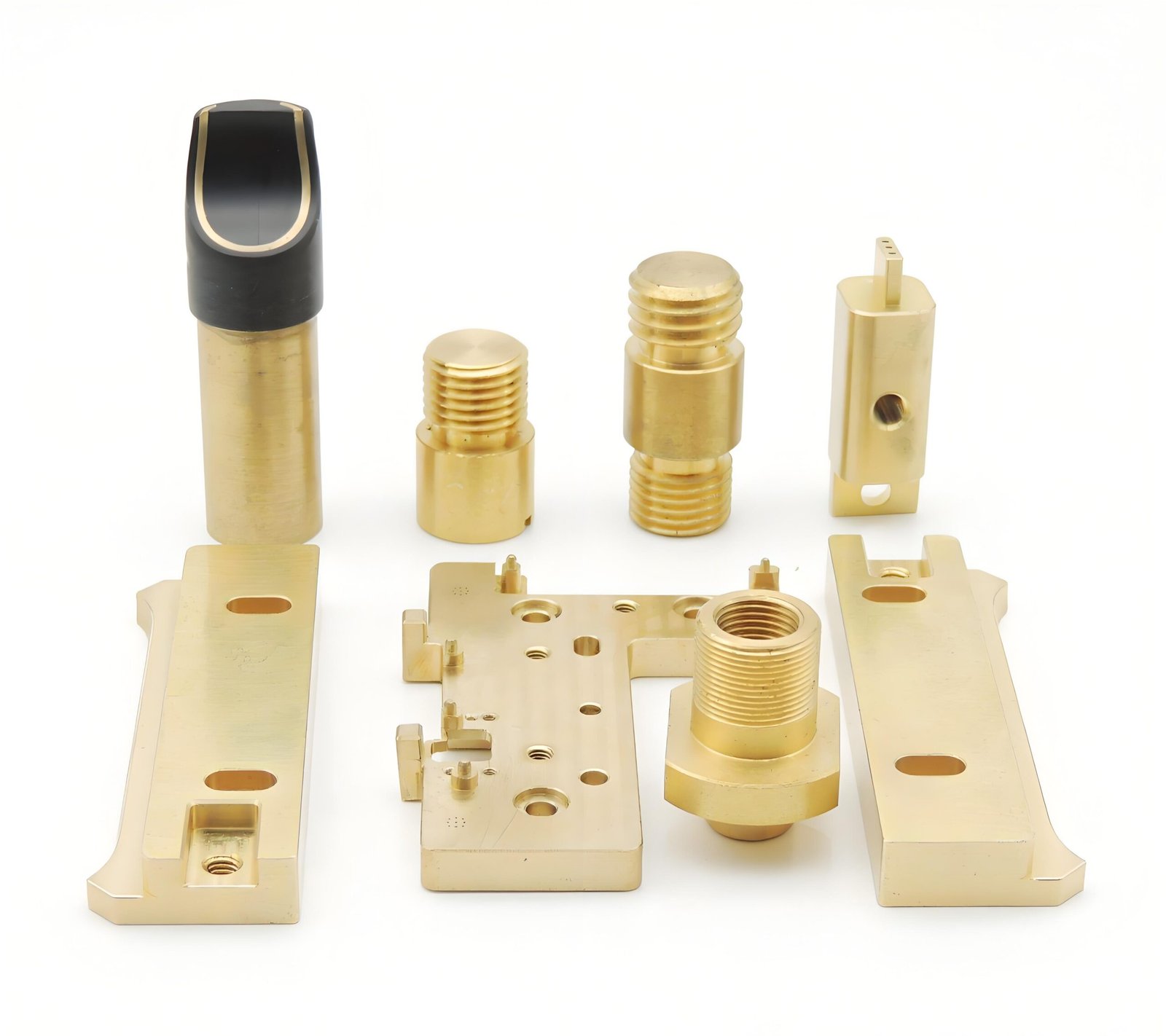
1. Precision: micron-level “craftsmanship”
Traditional machining relies on manual operation, the master’s experience and feel directly determine the accuracy of the product, the error is often in the millimeter level or even greater. CNC machining, on the other hand, precisely controls tool movement through a computer program, with a positioning accuracy of 0.001 millimeters (equivalent to 1/50th of the diameter of a strand of hair), and a repeatable positioning accuracy that is stable to within 0.005 millimeters.
This “ultimate precision” is critical in the field of precision manufacturing:
- In the medical industry, an error of more than 0.01mm in the curvature of the curved surface of an artificial joint can lead to postoperative pain in the patient;
- In the aerospace field, even a 0.1 millimeter deviation in the size of an engine blade may affect the power balance of the entire aircraft;、
- In the electronics industry, the assembly gap between the center frame and the screen of a cell phone needs to be controlled within 0.02 mm, otherwise there will be light leakage or stuttering.
CNC machining is like a tireless “precision craftsman” who, no matter how many pieces are mass-produced, ensures that each product is exactly the same size and shape – a stability that can never be achieved manually.
2. Efficiency: from “one piece per day” to “one batch per hour”
In traditional processing, a complex part may require multiple workers to operate lathes, milling machines, drilling machines and other equipment, repeated clamping, calibration, time-consuming days. CNC machining centers can complete the milling, drilling, boring, tapping and other procedures through a clamping, the process is compressed to a few hours or even minutes.
More critically, the “unmanned” nature of CNC machining dramatically improves time utilization:
- After completing the program debugging during the day, it can run automatically at night, realizing 24-hour uninterrupted production;
- When replacing a machined part, you only need to call up the corresponding program without readjusting the parameters of the machine, shortening the switchover time from several hours to a few minutes;
- For batch orders, once the program is set, the pace of production is determined entirely by the speed of the equipment, and is not affected by human fatigue or emotions.
This improved efficiency translates directly into cost advantages for the enterprise – especially in small-lot, multi-variety customized production, CNC machining can quickly respond to market demand and avoid the “line-change losses” of traditional machining.
3. Flexibility: “Seamless transition” from drawing to finished product
Today, with the accelerated iteration of industrial design, the product update cycle is getting shorter and shorter. If traditional machining encounters design modifications, it is often necessary to re-make jigs and fixtures and adjust equipment, which is costly and long. The core advantage of CNC machining is “flexible production”:
- Simply by modifying the CAD model and G-code program on the computer, new parts can be produced immediately without changing hardware equipment;
- Whether it’s a simple flat part or a complex three-dimensional surface (e.g., turbine blades, mold cavities), CNC machining can be achieved with 3-, 4-, or even 5-axis linkage;
- Supports machining of a wide range of materials, from metals (aluminum, steel, titanium alloys) to non-metals (plastics, wood, composites), adapted by simply adjusting tools and parameters.
This flexibility makes CNC machining a “right hand” in the R&D phase – designers’ ideas can be quickly transformed into physical prototypes, speeding up the process of taking a product from concept to mass production.
4. Complexity: Challenging tasks that were “previously impossible to accomplish manually”
Some parts are so complex that even the most experienced craftsmen can’t do anything about them: parts with deep cavities, slanted holes, spiral grooves, for example, or workpieces that need to be drilled with high precision anywhere on a curved surface. This is where the “multi-axis” technology of CNC machining comes into its own.
5-axis CNC machining, for example, allows the tool to rotate at any angle in three-dimensional space, moving around the part like a “flexible arm,” making it easy to machine complex structures that would be beyond the reach of conventional equipment. For example:
- The cylinder block waterway of an automobile engine, with its staggered internal curves, can be formed in a single pass by 5-axis machining;
- The carbon fiber frame of the UAV is thin-walled, shaped and lightweight, and CNC machining can precisely control the cutting force to avoid material deformation.
It can be said that CNC machining breaks the limitations of “structural complexity” in manufacturing and allows more innovative designs to be realized.
5. Cost: more “cost-effective” in the long run
Some people think that CNC equipment is expensive and the initial investment is large, but in a full lifecycle perspective, it reduces costs:
- Labor Costs: One CNC machine can replace 3-5 skilled workers, resulting in long term payroll savings;
- Material Utilization: By optimizing the cutting path, CNC machining is able to reduce material waste to less than 5%, compared to more than 20% for conventional machining;
- Scrap rate: Consistent accuracy means minimal rework and scrap, especially in the machining of high-value materials (e.g., titanium alloys, precious metals), where the cost savings can be considerable;
- Maintenance costs: Modern CNC equipment is highly reliable and can be serviced on a regular basis, with a failure rate much lower than the sum of multiple traditional machines.
For small and medium-sized enterprises (SMEs), it is even possible to circumvent the investment in equipment through the “OEM” model – simply provide a drawing and a professional CNC factory can quickly quote for production, which is a much lower threshold than one might think.
6. Datafication: the “Intelligent Cornerstone” of Manufacturing
- By analyzing machining data, tool life can be predicted and replaced in advance to avoid failure;
- Combined with AI algorithms, it can automatically optimize the cutting path to further improve efficiency;
- Production data is synchronized with the design side in real time, realizing the closed-loop iteration of “design – manufacturing – feedback”.
It can be said that choosing CNC machining is not only choosing a manufacturing method, but also paving a “highway” for the transformation of enterprises to intelligence and digitalization.